
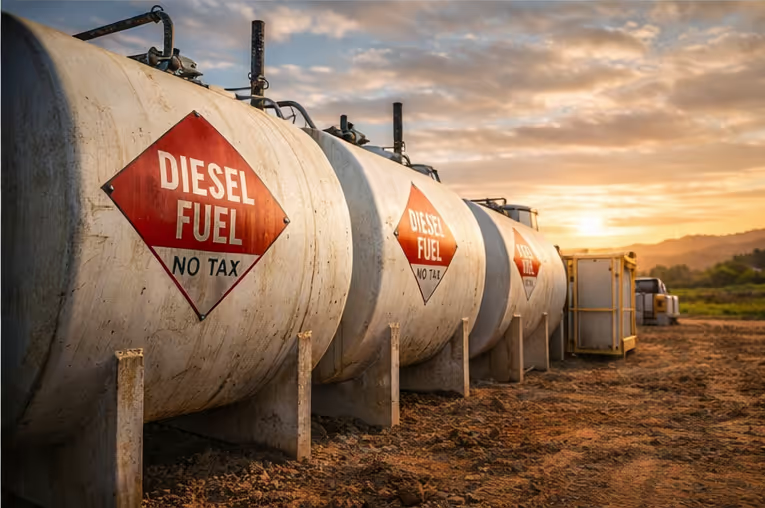
Most California operators with diesel equipment start on cardlock. It's convenient, the volume pricing is reasonable, and the reporting works. Bulk diesel delivery is a different model. The fuel comes to the site instead of the truck going to the fuel. The math for switching isn't simple. For some operations, bulk pays for itself inside six months. For others, the capital cost of storage never pencils. Here's how the decision actually gets made.
Quick Answer
Cardlock makes sense for over-the-road fleets, geographically dispersed operations, and lower-volume usage. Bulk delivery makes sense for yard-based equipment, high-volume single-location operations, and operations with a real fuel separation discipline (red dye vs clear). The switching threshold is usually around 1,000 to 1,500 gallons per month per location, plus the capital available for on-site storage.
| Factor | Cardlock | Bulk delivery |
|---|---|---|
| Per-gallon cost | Retail-adjacent with volume discount | Rack-plus pricing, typically lower |
| Capital investment | None | $5K to $50K+ depending on tank size and dispensing setup |
| Fueling location | Network locations, off-site | On-site, no trip required |
| Compliance load | Vendor handles | Operator carries SPCC, fire code, separation discipline |
| Best fit | Highway-heavy, dispersed | Yard-based, centralized, high-volume |
| Reporting | Per-card, per-driver, per-vehicle | Per-tank, per-equipment via internal logs |
What cardlock actually does well
Before talking about switching, it's worth being honest about what cardlock does well. Operators who switch away from cardlock without understanding what they're giving up usually end up unhappy with the switch.
Cardlock is built around a network. CFN, Pacific Pride, WEX, Voyager, Comdata, and a few others operate unattended fueling sites across California. A driver swipes a card, fuels the truck, and drives away. The transaction is logged automatically. The card can be restricted by vehicle, by gallon limit, by time of day, or by location. The reporting back-end is mature.
For a fleet that runs across geography, cardlock is a structural fit. A driver in Bakersfield, a driver in Sacramento, and a driver in San Diego can all be on the same account. The volume aggregates across the fleet. The card controls reduce theft and unauthorized use. There's no on-site storage to maintain, no SPCC plan to write, and no fire marshal interaction.
The per-gallon cost on cardlock isn't retail-pump pricing. Most commercial accounts negotiate a discount off the posted price, and high-volume fleets do meaningfully better than that. It's not bulk pricing, but it's not retail either.
The trade-off cardlock makes is convenience for cost. The fleet pays a premium per gallon for the network, the card infrastructure, and the absence of any capital investment in storage.
What bulk delivery actually does differently
Bulk delivery is a different operating model, not just a different price point. Understanding the difference is the first step in evaluating whether the switch makes sense for a specific operation.
In a bulk model, the operator has on-site fuel storage. A tank, a dispenser, a meter, and a containment system. Fuel gets delivered on a scheduled cadence (weekly, every two weeks, or based on tank-level monitoring) and dispensed on-site as equipment needs it.
The pricing model shifts. Cardlock pricing is retail-anchored, even with volume discounts. Bulk pricing is typically rack-plus: the wholesale rack price (what the supplier paid at the terminal) plus a delivery margin. The margin is negotiable based on volume, contract length, and delivery cadence. For operations that pencil for bulk, the per-gallon savings is usually 15 to 40 cents per gallon below cardlock-equivalent pricing, sometimes more.
The compliance load shifts too. The operator carries the storage compliance, not the vendor. That means an SPCC plan (Spill Prevention, Control, and Countermeasure) if the tank is over the federal threshold, fire code compliance at the state and local level, and the separation discipline between red dye and clear if both fuels are stored.
The operational tradeoff is real. Bulk requires the operator to do work that cardlock does for them: managing the inventory, managing the storage compliance, managing the dispensing infrastructure. The cost saving has to clear all of that.
For the broader fuel-planning context around off-road equipment specifically, the off-road diesel guide covers tank sizing, supply rhythm, and storage compliance in more detail.
The volume threshold most operators cross before they realize it
The most common reason operators stay on cardlock past the switching point is that they don't have a clear view of their actual monthly volume. The fueling happens transaction by transaction, the invoices come in monthly, and the total never gets aggregated in a way that surfaces the math.
The rule of thumb most California fuel operators work with: bulk starts to pencil somewhere between 1,000 and 1,500 gallons per month at a single location. Below that, the per-gallon savings doesn't recover the capital cost of storage in a reasonable timeframe. Above that, the math turns favorable, and the threshold for "really favorable" is usually around 3,000 to 5,000 gallons per month.
The math is straightforward in concept and messy in practice. The savings side is per-gallon delta (cardlock cost minus bulk cost) multiplied by monthly volume. The cost side is the amortized capital for the tank and dispensing setup, plus the operational time spent managing inventory and compliance, plus any new compliance costs (SPCC plan, fire code).
For a 2,000-gallon-per-month operation with a 25¢/gallon delta between cardlock and bulk, the per-month savings is $500. A $15,000 storage setup amortizes in about 30 months at that volume. That's the kind of math that makes operators wish they'd switched two years earlier.
For a 500-gallon-per-month operation with the same delta, the savings is $125 per month, and the same $15,000 setup takes ten years to pencil. Cardlock stays the right answer.
Most operators sit somewhere in between, and most don't know which side of the line they're on until they actually run the numbers.
The full cost picture neither model shows on its own
Per-gallon cost is the obvious comparison. It's also the incomplete one. The full cost picture has four components, and the cardlock invoice only shows one of them.
Per-gallon fuel cost. The line item operators always see. Cardlock is retail-adjacent, bulk is rack-plus, and the delta is usually 15 to 40 cents per gallon at meaningful volume.
Fueling downtime. The hour a driver spends getting to a cardlock, fueling, and getting back to the yard or job site is an hour the driver isn't producing revenue. For operations where the driver's hour costs $50 to $80 fully loaded, fueling downtime adds up fast. A crew that loses 30 minutes per truck per day across 10 trucks is 150 hours per month of time that bulk delivery just eliminates.
Compliance load. Cardlock's compliance is in the vendor's hands. Bulk's compliance is the operator's. The discipline of red dye versus clear separation, the SPCC plan if the storage threshold applies, the fire code interactions, and the documentation are all operator work. For operations that already have a real fuel separation discipline (per the off-road diesel rules), the marginal compliance cost is low. For operations that don't, it's meaningful.
Capital cost. The tank, the dispensing infrastructure, the containment system, the installation. Range from about $5,000 for a basic farm setup to $50,000+ for a multi-tank yard installation with monitored dispensing. The capital cost amortizes against the savings over time, but it has to be available up front (or financed, which adds carrying cost).
Add the four components together and the comparison gets more honest. Cardlock wins for low-volume, dispersed, highway-heavy operations because the savings on the per-gallon side doesn't cover the capital and compliance side. Bulk wins for high-volume, centralized, yard-based operations because the per-gallon savings plus the downtime savings clears the capital and compliance side with room to spare.
The hybrid operators (most operators) sit in the middle.
How most operations actually land: hybrid, not all-or-nothing
The cleanest mental model for the switching decision isn't "cardlock or bulk." It's "which equipment fuels from which source."
Most operations that switch from cardlock to bulk don't go fully bulk. They go hybrid. The yard equipment, the stationary generators, the on-site construction equipment, and the higher-volume daily-use trucks fuel from on-site storage. The over-the-road fleet, the geographically dispersed assets, and the occasional-use vehicles stay on cardlock.
The math works out by equipment class. The yard equipment fuels at high volume in a single location, so it pencils for bulk. The over-the-road truck that runs Sacramento-to-LA-to-San-Diego every week never gets back to the yard at predictable times, so it stays on cardlock. The light-duty service truck that runs around a single market might go either way depending on where it lives at night.
What the hybrid model needs is the same operational discipline a pure-bulk model needs. Storage separation for clear and red dye, fueling SOPs for the on-site equipment, documentation for the bulk side, and continued use of the cardlock controls on the road side. The supplier relationship handles the bulk side. The cardlock provider handles the road side.
This is also where the supplier relationship earns its place beyond just delivering fuel. A real bulk fuel supplier helps the operator size the storage, build the dispensing infrastructure, set the delivery cadence, and align it with the on-site equipment's actual consumption pattern. For operations that need to keep some volume on cardlock during the transition, fleet card programs often run alongside the bulk relationship rather than getting replaced by it.
The operators who land in the right model for their operation are the ones who run the math by equipment class, not by gut.
Frequently Asked Questions
At what monthly volume does bulk diesel delivery start to make sense?
The rule of thumb is around 1,000 to 1,500 gallons per month at a single location. Below that, the per-gallon savings from bulk pricing usually doesn't recover the capital cost of on-site storage in a reasonable timeframe. Above that, the math turns favorable. Above 3,000 to 5,000 gallons per month, bulk is usually meaningfully cheaper. Specific thresholds depend on the per-gallon delta and the capital cost of the storage setup.
Do I have to switch all my fuel to bulk, or can I keep some on cardlock?
Hybrid models are common and often optimal. Yard-based equipment, stationary engines, and high-volume daily-use vehicles fuel from on-site bulk storage. Over-the-road fleet vehicles, geographically dispersed assets, and occasional-use vehicles stay on cardlock. The math gets run by equipment class rather than fleet-wide.
What compliance load comes with on-site bulk storage?
The main pieces: an SPCC (Spill Prevention, Control, and Countermeasure) plan if total above-ground storage exceeds 1,320 gallons, local fire code compliance for the tank and dispensing setup, and operational discipline around red dye versus clear separation if both fuels are stored. For operations that already run a clean fuel separation, the marginal compliance cost is low. For operations starting from no on-site storage, it's a real new workload.
How much capital is required for a bulk diesel setup?
Range is wide. A basic 500-gallon single-tank farm setup with a manual dispenser can be assembled for around $5,000. A 1,000 to 2,000 gallon yard tank with metered dispensing and proper containment runs $15,000 to $25,000. A multi-tank yard installation with monitored dispensing, separated dye and clear storage, and proper SPCC infrastructure can run $40,000 to $80,000 or more. The right setup depends on volume, equipment mix, and growth plans.
How long does it usually take to amortize the capital cost of switching?
For operations that genuinely cross the volume threshold, amortization commonly runs 18 to 36 months on the capital alone, faster if downtime savings are included in the math. For operations below the threshold, amortization stretches out far enough that cardlock typically remains the better answer.
Want to run the switching math for your operation?
The honest answer to "should I switch from cardlock to bulk" is almost always "depends on your equipment mix and volume by location." Running the math takes about an hour with the right data.
Call Windecker at (209) 826-5658 ext. 2 to walk through your fueling pattern, volume by location, and operational mix. The conversation usually surfaces whether the switch pencils, whether a hybrid model fits better, or whether cardlock is the right answer for now. Most inquiries get a response within one to two business days. The contact page works for written questions.




.png)